 Thoughts by human, co-written by AI
The Agentic Product Engineer
There are three takes on AI and software engineering right now, and they're all wrong:
- "AI will replace engineers entirely" — it won't. Engineering is expanding, not disappearing.
- "Who needs engineers? Anyone can build with AI" — building something that looks cool in two days is not the same as building something useful.
- "AI code is garbage, real engineers write their own" — technically LLMs hallucinate, yes. But there are ways to minimize hallucination rates by orders of magnitude. That's a skill, not a limitation.
The stakes are real. GitHub Copilot now contributes 46% of code written by its active users. Shopify requires teams to prove AI can't do the job before hiring. The shift already happened — the question is whether you're navigating it or being navigated by it.
Here's what's actually happening: writing code without agent assistance is going away. Software engineering is not.
The real shift
The responsibility lines are blurring — in both directions.
Non-engineers look at AI agents and think: who needs a software engineer? I can build the whole thing myself. But engineers are thinking the exact same thing: why do I need a separate designer, product manager, or researcher? I understand the technology deeply, I can iterate on the product, the design, the ideas, the execution — and I can build something scalable.
Both are partially right. The role that's emerging — the agentic product engineer — isn't defined by your previous job title. It's defined by whether you've internalized a new mental model.
Who thrives:
- People who learn how agents work in depth — the tools, techniques, best practices, and anti-patterns
- People who shift their mental model entirely, not just bolt AI onto existing workflows
- People who understand why, how, and what — and can steer agents through hard problems
Who struggles:
- Skeptics who dismiss agents because "all they do is hallucinate"
- People who misuse agents or don't understand how to work with them effectively
- People who have access to the tools but haven't changed how they think
Whoever masters the agentic mental model will outpace outdated engineering, product, and design processes. It can apply to anyone — but whoever is operating with this mental model correctly is not the one at risk.
The depth problem
Now that engineering itself is no longer the bottleneck, what matters is what you build and how you steer the agents.
Everyone loves building shiny new toys. You get a dopamine hit from spinning up something that looks cool in two days. But building something actually useful requires dedication and a much deeper understanding of how things work. This is not vibe coding.
Agents resist exploring unfamiliar territory. When you push an agent into a problem space it wasn't trained on, it pushes back. It suggests simpler alternatives. It defaults to naive, average solutions — because that's what general-knowledge LLMs are trained to produce.
When an agent hits a roadblock and decides to pivot to a simpler solution — that's the moment that matters. Do you let it? Or do you stop it, make it double down, come up with evidence for why one approach is better, and reason through the problem instead of jumping to conclusions?
Someone without depth will pivot with the agent. They'll end up in the graveyard of average products — because anyone else can rebuild the same thing with their $20 subscription in less than a week. Why would anyone use your product?
"The skill to master isn't prompting — prompting was 2025. In 2026, it's context engineering."
Context engineering and backlog-mcp
Andrej Karpathy described it well: the LLM is a CPU, the context window is RAM, and you are the operating system — responsible for loading exactly the right information for each task.
This is the biggest pain point I face right now, and it's why I built backlog-mcp.
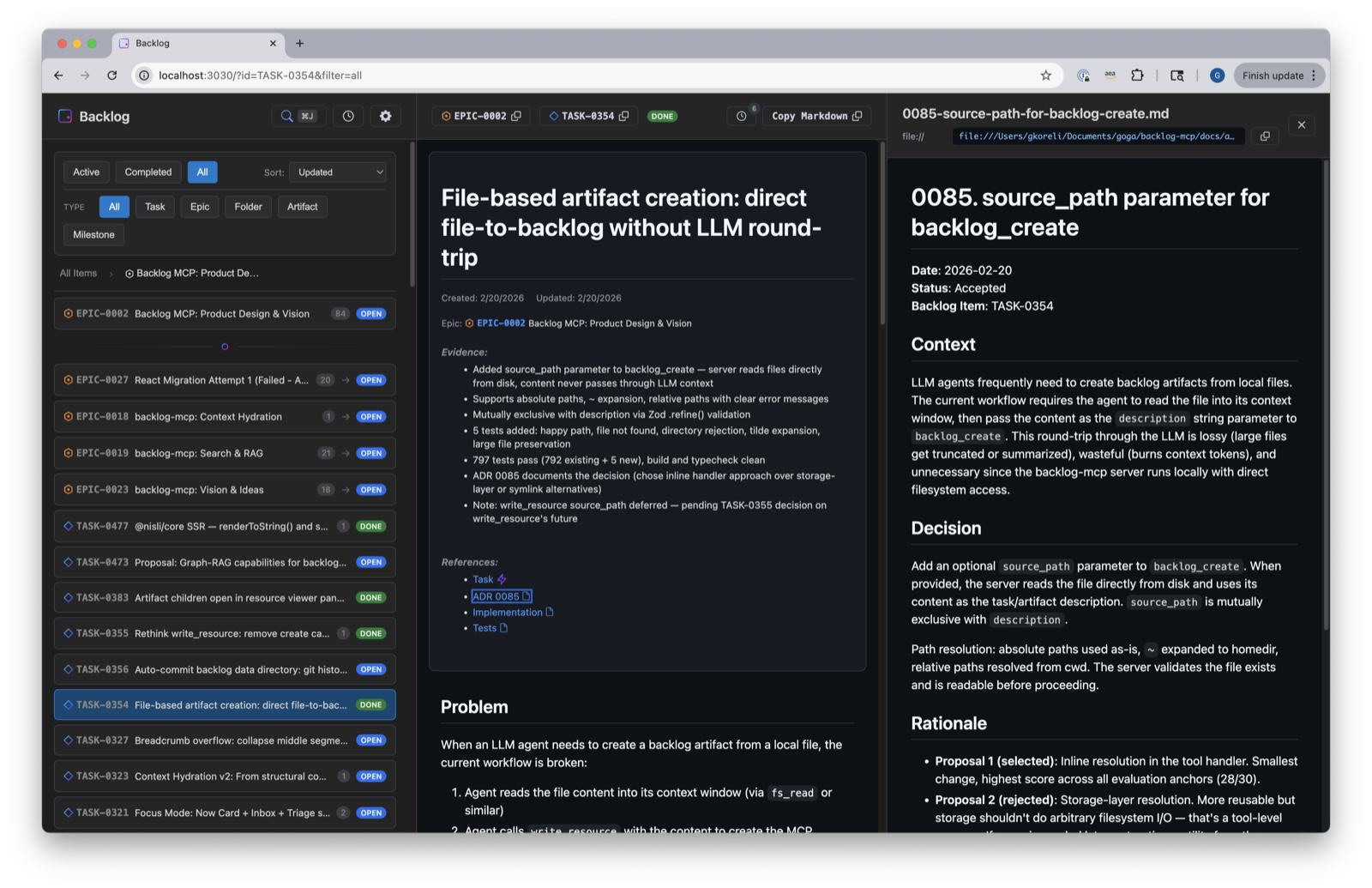
When you work with agents at scale, you accumulate data at an unprecedented pace — tasks, decisions, architecture records, research artifacts. You need RAG, vectors, and semantic search to extract value from it. And you need a human-first interface to wrap your mind around what's happening.
backlog-mcp is an MCP server that gives AI agents their own task management system:
backlog_search— semantic search across everything you've ever worked onbacklog_context— engineer the right context before starting any task by finding related past work- Live activity panel — every agent action logged and visible in real time
- Disk-first storage — every task mutation stored on your filesystem, not in a cloud you don't control
The mutation layer is agent-first: agents create, update, and organize. The reading layer is human-first — a readonly backlog-viewer where you can wrap your mind around everything.
My future goal: train my own model on the personal data I'm accumulating. All the work, all the distillation, all the decisions — this data is uniquely valuable because it captures not just code, but the reasoning behind it.
@nisli/core — born from real pain
@nisli/core didn't start as a framework project. It started because the backlog-viewer was falling apart.
The viewer had grown into a proper web application — global search, live activity panel, full task management UI. But it was built with vanilla web components, and polling would re-render entire pages. I'd lose track of what I was looking at. The code was becoming unmaintainable.
So I built a framework. Zero dependencies. ~2,600 lines of TypeScript. A mix of everything I've loved from a decade of working with UI frameworks:
- Angular's dependency injection
- Signals — the pattern trending across the ecosystem
- Lit's HTML templating engine
- Vue's reactivity model
- React's functional components
import { component, html, signal, computed } from '@nisli/core';

const count = signal(0);
const doubled = computed(() => count.value * 2);

component('my-counter', () => {
  return html`
    <button @click=${() => count.value++}>
      ${count} × 2 = ${doubled}
    </button>
  `;
});
Built over a weekend. Full migration of the backlog-viewer with zero regressions. The entire journey is captured in the git history. nisli/core lives inside the backlog-mcp monorepo, and I'll continue building both. I have many more tool ideas — this is just the beginning.
This blog is the proof
You're reading a site built with @nisli/core. The build pipeline is a custom SSG — markdown in, static HTML out, nisli web components for interactivity. The theme toggle in the sidebar? Signals and effects. The code blocks? Shiki dual themes rendered at build time, switching with zero JavaScript.
No React. No Next.js. No Gatsby. Just my framework, some markdown, and esbuild.
How this blog is written
"I use AI agents heavily, including for writing these articles. But this is not AI slop. Far from it."
I feed the agent with golden data — my perspective, ten years of engineering experience, the specific problems I've faced, the lessons I've learned from doubling down instead of pivoting. The agent helps me write. I provide the substance.
We don't need ten blog posts generated in ten minutes. We need valuable lessons built out of real pain and pragmatic use cases.
Every post on this blog will include:
- The raw prompts I wrote to generate it — my actual thinking, unpolished
- The polished output — what the agent produced from that input
- The edits — what I changed and why
So you can judge for yourself whether coming back here is worth your time.
I merged 100 PRs in a month building these tools. I have many more to build and lessons to share. This blog is a builder's journal — specifics over polish, decisions over tutorials.
Next up: how @nisli/core's template engine works — and why zero dependencies is a design decision, not a constraint.
Glossary
| Term / Claim | Source | Date |
|---|---|---|
| Vibe coding | Andrej Karpathy on X — coined the term: "fully give in to the vibes, embrace exponentials, and forget that the code even exists" | Feb 2025 |
| Context engineering | Andrej Karpathy via LangChain — "the delicate art and science of filling the context window with just the right information for the next step" | Jun 2025 |
| Context engineering as the next frontier | deepset — why context engineering matters more than prompt engineering for production AI | Jul 2025 |
| Shopify AI-first hiring | Tobi Lütke memo via BetaKit — teams must prove AI can't do the job before requesting headcount | Apr 2025 |
| Vibe coding limitations | Columbia University DAPLab — vibe-coding workflows lack transparency when they fail; recovery from breaking changes is the critical liability | Jan 2026 |
| Developers as orchestrators | Steve Yegge on Pragmatic Engineer — shifting from writing code to orchestrating fleets of AI agents | Feb 2026 |
| MCP (Model Context Protocol) | Anthropic — open protocol that standardizes how applications provide context to LLMs | Nov 2024 |
| GitHub Copilot adoption | Copilot statistics — 20M+ users, contributes 46% of code written by active users | Jan 2026 |