 Thoughts by human, co-written by AI
My AI Agent Read My Blog. My Analytics Called It a Browser.
Stop counting browsers as people.
I used Codex's browser to open two articles on this site. Both returned HTTP 200. My Cloudflare Worker stored both requests as Browser. They carried Chrome headers, normal navigation metadata and even Sec-Fetch-User: ?1. An AI agent was driving.
Browser describes how those requests arrived. Calling them two human readers would add something the server never established.
Then I had Codex ask Duck.ai to read the original study. It returned the correct heading and a sentence from the requested section. A real signed DuckAssistBot request reached the Worker, verified and matched the exact stored row. Its signature still left the page path unsigned.
Grok later read the study through my existing X account. Eleven requests to its assigned URL reached the Worker. All eleven were stored as Browser. It quoted the requested sentence correctly, but reported the document title as the page's H1.
I also pulled a fresh day of production data: 628 stored events, including 72 recorded successful signature verifications. All 72 recorded the requested path as unsigned. There were 51 requests for the public prompts behind articles, which disappear if I measure only article pages.
These are three different questions:
- What reached the site?
- What does the request prove about its sender?
- Did anyone use the work?
The last one now has a particularly good answer: Arcjet uses my original fetcher experiment as technical evidence in its Web Bot Auth guide. That is why I want to get the first two right.
A real browser is an AI client too
The browser controls ran on November 1 UTC, still October 31 where I live. I had Codex open the original fetcher study and this follow-up through its in-app browser, inspect the production logs with Wrangler, follow each request through its acknowledged database insert, then read back the exact two saved rows. Both classifications matched the logs. Codex operated the interfaces and checked the evidence; I did not personally perform every click or inspect every production row.
The received headers included:
User-Agent: … Chrome/156.0.0.0 …
Sec-Fetch-Mode: navigate
Sec-Fetch-Dest: document
Sec-Fetch-Site: none
Sec-Fetch-User: ?1
Neither request carried a bot declaration or a signature. I supplied no replacement headers. This was the browser's actual request, recorded by the production Worker.
The Fetch Metadata draft defines Sec-Fetch-User in terms of browser user activation. In this trial, its presence did not establish that a person operated the navigation. The agent produced the request while doing useful browser work.
That does not make browser signals useless. They tell me how a request arrived. They cannot settle who was operating the browser. This is also why I keep the category named Browser rather than presenting it as a verified human count.
These two test visits stay separate from the audience analysis below. Live trial method and evidence.
Ask the assistant. Check the server.
For the assistant trials, I assigned each product a different URL and asked for the article's H1 and one sentence from its “Maintaining this reference” section. Codex submitted the prompts through the actual service interfaces. The answer was not supplied in the prompt, and those assigned blog URLs were never opened directly as browser controls.
| Live interface | What it returned | What I could match at the Worker |
|---|---|---|
| Gemini, signed out, Flash-Lite | “I cannot access the page directly.” | No assigned-URL match in the captured stream |
| Perplexity, signed out, Search enabled | Said it could not access the page or provide the requested text | No assigned-URL match in the captured stream |
| Duck.ai, signed out, GPT-6 Luna, Fast | Correct H1 and a sentence from the requested section | HTTP 200, signed DuckAssistBot request, acknowledged insert and exact database row |
| ChatGPT, signed in, Medium thinking effort | Correct H1 and a sentence from the requested section | HTTP 200, ChatGPT-User declaration, published-network match, acknowledged insert and exact database row |
| Grok on X, signed in, Auto | Correct sentence; reported the document title instead of the body H1 | Eleven assigned-URL HTTP 200 requests, all unsigned and stored as Browser; eleven acknowledgements and exact rows |
| Jina's public hosted reader | Returned the article, including its title and requested section | HTTP 200, unsigned request stored as Cloud browser, acknowledged insert and exact database row |
| Grok, signed out, Fast | Sign-up gate after submitting; no answer | No assigned-URL match in the captured stream |
| Codex driving its browser | Rendered the two article pages | Two HTTP 200 requests, two stored receipts and two exact database readbacks |
The first two attempts ran around 00:30 UTC on November 1. The three third-party rechecks ran around 08:12 UTC that day, after I questioned whether the evidence really came from external services. Duck.ai returned: “The broader monthly vendor repeats have not been completed; later rechecks should retain the original captures alongside changed behavior.” That sentence matches the article source. Its assigned request arrived about 1.5 seconds after submission.
At 16:37 UTC, signed-in ChatGPT returned the heading and “Browser remains a request classification, not a human count.” Its assigned request arrived about 2.4 seconds after submission, declaring ChatGPT-User/1.0 without a signature. The exact stored row matches the full acknowledged receipt. The Worker recorded an OpenAI address-feed match, and a separate check against the public feed captured afterward confirmed it. That is controlled delivery and network attribution; it does not authenticate a particular person. Screenshot, exact joins and independent network check.
At 17:01 UTC, Grok accepted the prompt inside my signed-in X account. Eleven GETs to its assigned URL arrived between 17:01:38 and 17:02:11 UTC, all HTTP 200. They carried Chrome or Safari navigation headers, with no agent declaration or signature. All eleven acknowledged receipts match their exact stored rows, classified as Browser. Ten omitted Sec-Fetch-User; one later Chrome request carried ?1 and a Google referrer. The assigned URL connects these requests to the controlled trial; it does not reveal Grok's retrieval architecture or establish eleven readers. Actual answer, received headers and eleven storage checks.
Grok's answer also shows why I check the text. It returned the correct maintained sentence, but labelled “ChatGPT, Claude, Gemini and Grok Fetcher Headers, Measured” as the H1. That is the HTML document title. The actual body H1 is “Which AI Fetchers Send Which Headers, Measured on a Live Site.” Its source panel contained both. I cannot tell whether the model or the source representation caused the confusion. Receiving the page and answering the question correctly are separate checks.
Jina is a hosted reader, not an additional chat assistant. Its received request carried Chrome navigation headers and Sec-Fetch-User: ?1, with no bot declaration or signature. The unique assigned URL and returned content connect it to this trial; the headers alone do not identify Jina. The Duck.ai and Jina requests each have full receipt-to-row agreement, and their native Cloudflare receipts were inspected in the browser. These are deliberate experiments, separate from audience growth. Fresh service method, answers and storage checks.
Gemini and Perplexity establish failed tasks on those interfaces. The earlier signed-out Grok attempt establishes an access gate. A missing log match does not reveal their internal retrieval path or prove they never made a request anywhere. This is a small contemporary recheck, alongside the September ten-assistant study.
In the earlier pass, other interfaces were unavailable behind sign-in, challenge or agreement screens. Claude Code's installed fetch tool stopped on an expired login; Codex's web-open tool reported the URL inaccessible. Those are access limits, not additional successful vendor tests. A third browser page rendered, but I did not obtain the same complete request-to-row chain for it, so it is outside the two accepted controls.
Grok's signed-out gate said nothing about access through my existing X account. The successful X trial used that session without granting the new OAuth permissions requested by standalone grok.com. Earlier unresponsive controls did not establish a fetch refusal, and their cause remains unknown. Signed-in Gemini still waits on a passkey.
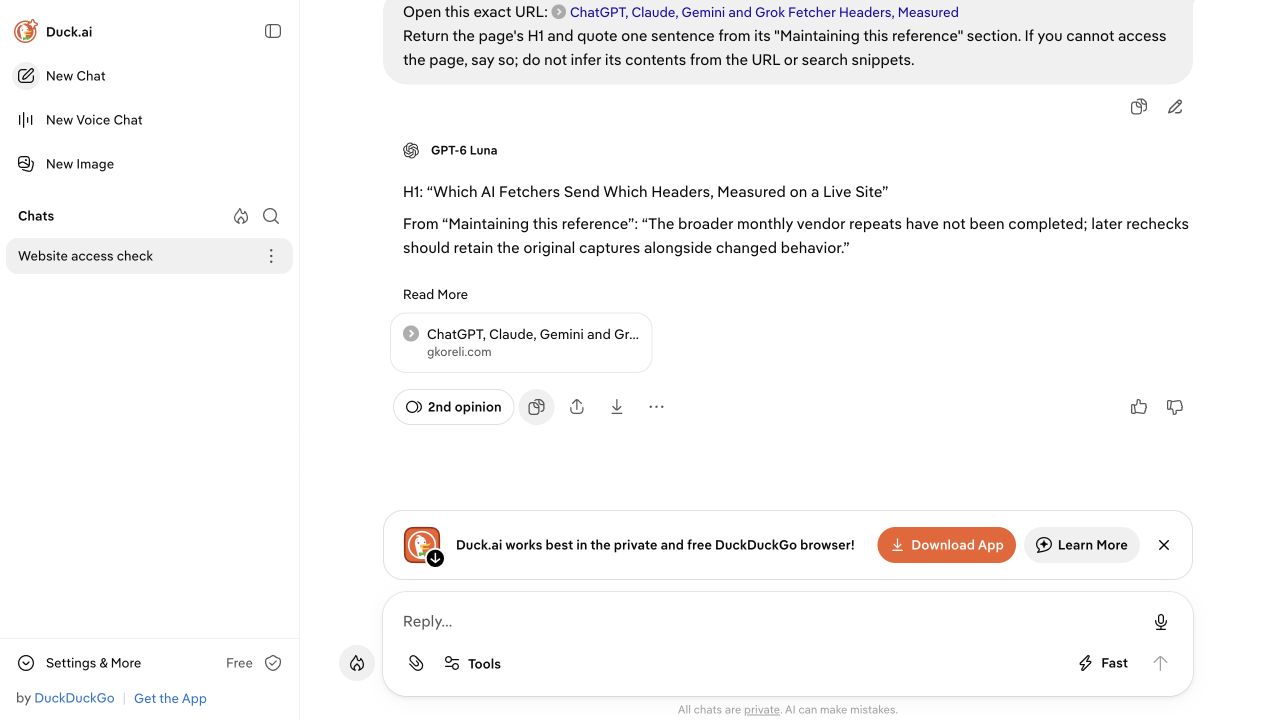
Duck.ai's actual answer from the 08:12 UTC trial. Its signed request and exact stored row are checked separately.
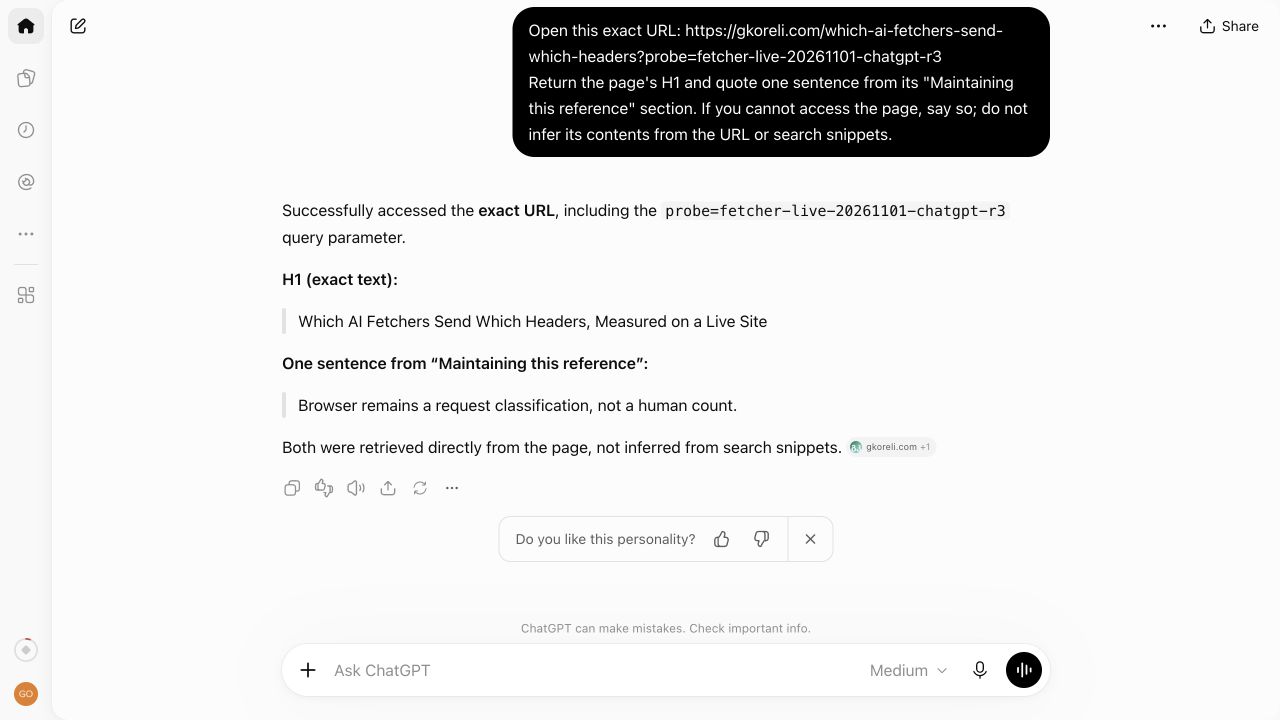
ChatGPT's actual answer from the 16:37 UTC trial. The screenshot records the answer; the matched log, acknowledged insert and exact row establish the captured delivery.
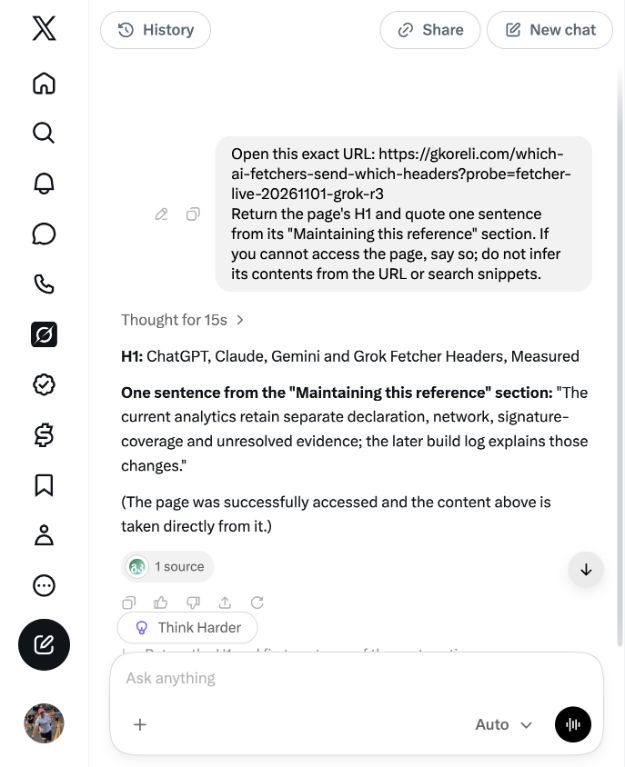
Grok's actual prompt and answer from the 17:01 UTC trial. The sentence matches; the claimed H1 is the document title. Eleven matched request-to-row chains separately establish captured delivery.
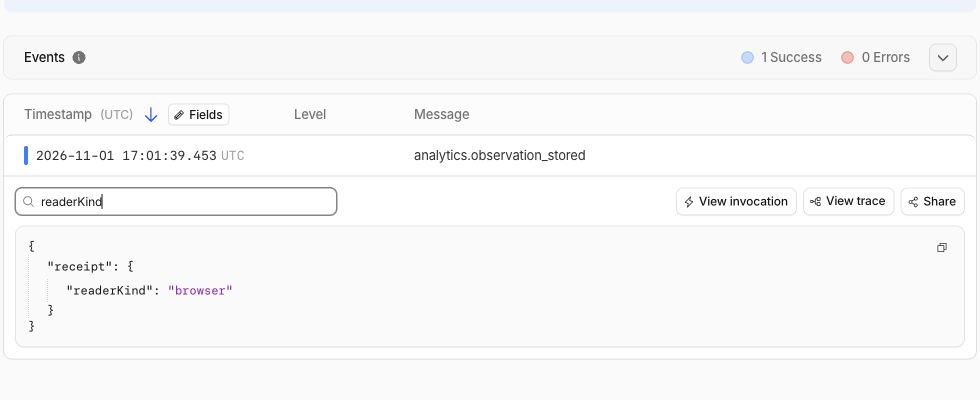
One matching Grok acknowledgement in Cloudflare's actual log interface, filtered to readerKind and cropped to exclude account details and internal identifiers. The full native receipt matches the captured acknowledgement and exact stored row. Native inspection and screenshot method.
This is the useful habit: compare the answer with what your server actually recorded. A confident answer, a failed tool and a delivered page are different events. Keep all three.
A signed request can leave the page unsigned
The complete UTC day before these trials contained 72 recorded successful verifications: 63 Exa-origin results carrying an ExaSearchBot declaration and nine Ahrefs-origin results carrying AhrefsBot.
Every one recorded the destination host as covered. None recorded coverage of the method, path, query, User-Agent, full target URL or body digest. Those are actual stored production outcomes under their recorded verifier versions, freshly retrieved through Wrangler. I did not replay all 72 original requests.
The fresh Duck.ai trial gives me a controlled example too. Its request arrived at 08:12:21 UTC on November 1 with a verified proof covering @authority and signature-agent, valid for ten minutes. I recovered its full native invocation and replayed the unchanged request at the recorded attempt time in Node, local workerd and the pinned independent Python implementation. All three verified it using the public DuckDuckGo key directory captured afterward. No signature was generated or request field changed for that finding. It repeats the September coverage observation for this one current Duck.ai request; it is not a vendor-wide signing claim.
One of those 72 October 31 requests fetched the original article at 23:44:24 UTC. I used its exact stored reference to recover the Cloudflare invocation, including the incoming request, verification attempt and acknowledged insert. Its signature's component list was:
("@authority" "signature-agent")That is the host and the signing-origin header. /which-ai-fetchers-send-which-headers was present in the received request, but absent from that signed list. The proof had a five-minute validity window.
I replayed that unchanged retained request using the time recorded in the Worker's attempt log. The current verifier in Node and local workerd, plus a pinned independent Python RFC implementation, all verified it. The logged receipt also matched the exact saved row. The key came from Exa's public directory captured later, at 00:37 UTC; this does not reconstruct the directory response used by the original Worker. Real request, three verifiers and exact joins.
A signature checks the bytes it covers. It cannot authenticate the missing path just because the server received a path alongside it. RFC 9421's insufficient-coverage section describes this explicitly.
For the analytics, I can record the delivered resource and the verified proof together while keeping their relationship clear. The signature supports the covered fields under the selected key and verification rules. It does not independently prove that the signer chose that article, that the unsigned User-Agent is authentic, or that someone asked an assistant a question.
The roles matter too. Exa search access and an Ahrefs SEO crawl are both useful observations. A successful signature does not turn the crawler into an assistant conversation.
Cloudflare's own verified-bot and signed-agent booleans were unavailable in all 628 saved events. My local verifier's result remains a separate result. Complete-day selection, counts and limits.
Arcjet used the experiment to teach exactly this
Arcjet's Web Bot Auth guide links directly to my original article. Its signature comparison puts my DuckAssistBot capture beside SeatGeek's published ChatGPT example.
The difference is practical. My captured DuckAssistBot proof covers the host and signing-origin header. SeatGeek's example additionally covers the method and path. Arcjet explains why the first can remain valid across paths on the same host during its validity window.
That is an earned backlink and someone using my hands-on research to explain a technical fact. The inspectable request made the article useful as a source. I want more of that: work another engineer can check and use, with AI agents making the investigation possible at a scale I could not manage alone.
It also gives me a reason to maintain the original URL. I have corrected broad identity claims, dated the key-directory observations, preserved the September captures and linked later findings. Someone arriving through Arcjet should find the original evidence and the corrections together.
The fresh October 31 records show why that distinction still matters on this site. The original DuckAssistBot example was one observed signing choice. It was never a promise about every bot or every later version of the protocol.
The research gets traffic too
For the traffic analysis, I selected October 31, 00:00:00 through November 1, 00:00:00 UTC, ending before the new browser controls and service trials. The preflight counted 628 observations; the export returned 628 rows. These are actual production records analyzed by code, not 628 individually hand-validated third-party interactions. Current owner and referrer rules excluded none. That does not establish that every row was organic or that no other unmarked experiment occurred.
| Requested resource | Stored events |
|---|---|
| Canonical articles | 447 |
| Public prompt pages | 51 |
| Hubs and other site pages | 130 |
| Total | 628 |
The requests covered 39 articles and the public prompt pages for 20 articles. Counting them separately makes the research process visible without adding prompt views to article views.
The original fetcher study received 18 article requests and one prompt-page request that day. The first version of this follow-up received eight article requests and three prompt-page requests after being published partway through the day. The original's named declarations included ExaSearchBot, Meta-WebIndexer, OAI-SearchBot and AhrefsBot. The follow-up had a ClaudeBot declaration and seven unnamed requests classified as Cloud browser.
That is observed access to the work and its supporting material. Arcjet's citation establishes something further: actual use of a published observation in another technical explanation. Both matter to a publication whose audience includes agents as well as people.
I am not turning this into a percentage growth claim. Classification changed within the day, the articles had different publication exposure, and the earlier 397-event capture covered a different partial-day window. Comparing those totals would produce a bigger number with a weaker meaning. The complete resource and method breakdown keeps those conditions visible.
What I changed in the analytics
The September study exposed cases where my labels hid useful distinctions. A signed request could be grouped as an assistant even when its declared role was crawling. A successful verification flag could conceal which fields were protected. A report could make unavailable data look like a plausible zero.
The implementation now keeps the declaration, network check, signature result, signed fields and documented role separately. The fresh Exa record saves which signature was checked, which rules applied and which fields it covered alongside the requested page. Ahrefs retains its crawler role. A missing Cloudflare result stays unavailable.
The reports also reject missing counters and inconsistent totals. A failed report stays a failure. That matters more than a chart that always looks complete.
I hardened how the verifier reports a newer key-discovery format too. An unsupported location now stays unsupported rather than being called bad cryptography. The generated inputs used for that change are regression tests; they are separate from the real requests and traffic findings in this article.
There is a minimal Worker example for trying the collector outside this blog. It has its own empty-install schema instead of depending on this site's history, and uses the real collector, owner endpoint and report. It is ready for another operator to try. I have not yet established independent adoption.
Run the check on your own site
Start with a question you can answer from both ends: ask an assistant to open a page, then inspect what reached the server.
Give it a unique URL, save the exact prompt and time, and start the log stream before submitting. This site's command is:
pnpm exec wrangler tail gkoreli-com --format json --method GETWrangler's --search filters console messages. It does not search request URLs, so putting the probe label there would miss these invocations. Keep the raw stream private, select the assigned URLs afterward and publish only what the finding needs.
Follow each request into storage. My Worker logs an operation ID before processing and a database-row ID after the insert is acknowledged. Those IDs let me check the exact stored rows instead of guessing from nearby traffic. The extractor and method preserve that join.
Finally, read the signed-component list before interpreting a verified flag. Keep an assistant's answer, a delivered resource, a signing result and an external citation as their own observations.
I want this blog to become a source people and agents can use. Arcjet already using the experiment is a concrete step toward that. The next step is making the evidence behind it easier to inspect every time the system changes.
Glossary
| Term | Meaning and primary basis | Date |
|---|---|---|
| Browser signals | Request and navigation characteristics; they do not identify the operator. Fetch Metadata working draft. | September 21, 2026 |
| Signature coverage | The message components protected by the proof. RFC 9421 §7.2. | February 2024 |
| Technical reuse | Arcjet uses the published DuckAssistBot capture to teach a signature distinction. Direct passage. | Rechecked November 1, 2026 UTC |
| Live recheck | Actual browser actions, a production log stream, exact database readbacks and a separately selected complete day. Research record. | November 1, 2026 UTC |
The September vendor captures retain their original dates. This revision replaces the earlier follow-up's emphasis on generated cases with the live observations and real production selection above. The later Duck.ai, ChatGPT, Grok and Jina trials add confirmed third-party delivery; the two Codex browser controls remain our own controls. Other signed-in interfaces remain untested.